Tag Archives: Science Experiments

Density – Marbling Paper

Density – Marbling Paper

The Science of a Piece of PaperFind More Science Experiments

Density  is how close together the molecules of a substance are or how much mass a substance has in a given space. If you have one cup of jelly beans and one cup of marshmallows…the jelly beans have more mass…there is more “stuff” compacted into the cup. The marshmallows are mostly air. If you put each of those cups in a microwave to melt…the sugar and water that makes up the jelly beans would almost fill the cup to the top. The sugar and water that makes up the marshmallows would only fill the cup a little bit because marshmallows have less mass, they are mostly made of air. Materials with more density weigh more. A cup of jelly beans weighs more than a cup of marshmallows.

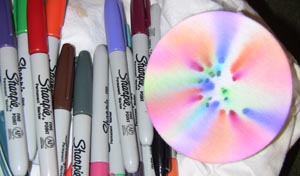
If you pour two substances of different density in a pan, the material with more density is heavier and will sink to the bottom. Watch this happen be using oil, water and food coloring to make marbled paper.

What You Need:

  •  Shallow Pan (like a brownie pan)
  • Water
  • Food Coloring
  • Cooking Oil
  • White Paper
  • Fork
  • Cups

You need one cup for each color of food coloring you have. Put a tablespoon of cooking oil in each cup. Add a couple drops of food coloring to each cup – one color in each cup. Stir each oil/food coloring mixture really good with a fork.

Now fill the shallow pan about half way with water. Take each cup and pour a little of the oil/food coloring mixture into the water. Put each color in a different section of the pan. Swirl the colors with a fork. When you like the pattern, lay a clean white sheet of paper on top of the water. Leave it for 30 seconds and then carefully lift it off and lay it down to dry. Pretty!

Water has more density than oil. Materials with more density weigh more. Any substance that has less density than water will float. The food coloring doesn’t mix with the water, it just floats with the oil and makes swirl patterns.

Here are some websites and books with density information and experiments:

The Science of a Piece of Paper How Big How Heavy How Dense

Words to Know:

Density – How closely packed together the molecules of a substance are.
Mass - How much matter fits in a given space.
Matter - Stuff
Weight - A measure of the force of gravity on an object. Materials with more density weigh more.
Volume – How much space a substance takes up.
*****The confusing relationship between weight and mass: On earth, a bowling ball can weigh about 10 pounds. If you take that same bowling ball to the moon it will weigh much less because the graviational pull of the moon is less than the gravitational pull on the earth. Weight is a measure of gravitational pull. So the weight of the bowling ball, or anything else, changes depending on where you weigh it. The mass of the bowling bowl does not change no matter where it is. The bowling ball has the same amount of mass  on earth as it does on the moon or anywhere else you take it.

Print This Post Print This Post

Chemical Reaction – Milk Glue

Chemical Reaction – Milk Glue

srpglue

Find More Science Experiments

What You Need:

  • Milk
  • Vinegar
  • Baking Soda
  • Coffee Filter or Paper Towel
  • 2 Large Cups
  • Bowl
  • Spoon

Pour 1/2 cup of milk into a large cup. Add 2 teaspoons srpmilkglassvinegar. Mix. Place a coffee filter or paper towel over a second large cup. The coffee filter should sag a little bit to make a little filter bowl. Put a rubber band around the top of the cup so it holds the coffee filter in place. Now pour the milk/vinegar mixture into the filter bowl you made.

Let the liquid part of the mixture drip through the filter. This might take awhile. When the liquid is done dripping use a spoon to scrape the milky lumps off the coffee filter and into a bowl. Add 1/4 teaspoon baking soda to the lumps and mix. Is this substance getting sticky? Try it out – can you use it to glue two pieces of paper together?

When the milk and vinegar (an acid), mix together a chemical reaction takes place. A substance called Casein forms. Casein is a very long molecule that bends like plastic – that’s why the lumps of milk are pliable and bendy. When you add baking soda (a base) to the milk lumps another chemical reaction happens turning the milk lumps into a sticky glue.

Science Experiment Idea: Make three batchs of milk glue, but make the variable (the thing you change) the amount of baking soda you add to the mixture. If you add 1/8 teaspoon baking soda to one batch, 1/4 teaspoon baking soda to one batch and 1/2 teaspoon baking soda to one batch, which one will be the most sticky? Why do you think so?

Here are some books and website that will help you make and understand glue made from milk:

Naked Eggs and Flying Potatoes Milk and Cheese

Words to Know:

Chemical Reaction – When a substances or substances is changed into a new substance.
Acid – A chemical that is often sour tasting and corrosive. It dissolves some things.

Print This Post Print This Post

Polymers – Borax Goo

Polymers – Borax Goo

Find More Science Experiments

What You Need:

  • White Glue
  • Borax (In the Laundry Detergent Aisle)
  • Water
  • Bowl
  • Ziploc Bag
  • Measuring Cups
  • Spoon
  • Cookie Sheet
  • Food Coloring (Optional)

Measure 1 cup water into an empty bowl. Add 2 teaspoons of Borax to the water and stir until the Borax is dissolved. Now put 1/2 cup white glue in a ziploc bag and add 1 cup water. Seal the bag and squish to mix the glue and water. Now add the water/Borax mixture to the ziploc bag. Reseal the bag and squish it some more. After you mix it for awhile empty the ziploc bag out onto the cookie sheet and mix it with your hands. Borax Goo is like Cornstarch Goo – it’s a non-Newtonian fluid. That means that sometimes it acts like a liquid and sometimes it acts like a solid.

Sir Isaac Newton is famous for figuring out certain rules that apply to things on earth. One of his rules is that matter can take three forms: solid, liquid and gas. Liquids flow and take the shape of the container they are in. The Gak/Flubber/Gluep seems like a liquid because it flows off your fingers and it takes the shape of the container you put it in. But when you squeeze the Gak/Flubber/Gluep…it turns into a solid. So which is it? A liquid or a solid? It’s a non-Newtonian fluid because it doesn’t behave by Sir Isaac Newton’s rules.

Gak/Flubber/Gluep is also a polymer. That means it’s molecules are arranged in a long chain. When the chain of molecules stretches…like the goo flowing off the fingers in this photo, the goo behaves like a liquid and flows. As soon as the Gak/Flubber/Gluep has pressure applied to it – like when you squeeze it in your fist or when you rest your hand on it in the tray, it behaves like a solid and feels stiff and strong.

Usually matter turns into a liquid when it is heated and when liquid is heated it “gets runnier.” How easily a liquid flows is called viscosity. Water has a low viscosity and flows fast. Honey has a high viscosity and flows slowly. If you heat honey or lava…it flows faster. That is one of Sir Isaac’s rules too…that the viscosity of liquids goes up as the liquid is heated. With Gak/Flubber/Gluep, the viscosity is changes when you put pressure on it instead of when you heat it.

Science Project Idea: Get three bowls and measure 1 cup of a powdered substance into each bowl. 1 cup of borax in bowl #1, 1 cup of baking soda in bowl #2 and 1 cup of flour in bowl #3. If you step back and look at the bowls they will all look pretty much the same – a bowl with white powder in it. Now pour 1/2 cup of water into each bowl and mix each bowl with your fingers. Do the mixtures behave the same? How do they behave differently? How would you describe each mixture? A solid or a liquid? You could also try baking soda and powdered sugar and cornstarch.

Here are some websites and books to help you experiment with your own slimy Gak/Flubber/Gluep or whatever you want to call it.

Naked Eggs and Flying Potatoes Plastics and Polymers Plastics and Polymers Science Fair Projects Experimental Chemistry

Words to Know:

Polymers – Molecules arranged in a long chain.
Non-Newtonian Fluid – A fluid that doesn’t flow like you would expect when you put pressure on it.
Liquid – A state of matter. In the liquid state, matter can flow or take the shape of the container it is in.
Viscosity – How resistant to flowing a liquid is. Water has low viscosity and flows fast. Honey has high viscosity and flows slow.

Print This Post Print This Post

Engineering – Build a Bridge

Engineering – Build a Bridge

Amazing Bridges to Design Build and TestFind More Science Experiments

What You Need:

  • Dry Spaghetti, Fetuccine, Straws or Bamboo Kabob Skewers
  • Small Gumdrops,  Small Marshmallows or Square Carmels

Here are some websites and books that will help give you great ideas for designing and building your own bridge. Make a simple design and then try to build it with different materials. Which materials work best? Can you figure out why?

Amazing Bridges to Design Build and Test Fabulous Bridges How Did They Build That Bridge
Print This Post Print This Post

Surface Tension – Sand Castles

Surface Tension – Sand Castles

srpsandcastleFind More Science Experiments

If you have ever tried to build a sand castle you know that there is a certain kind of wet sand that is perfect for it. If there is too much water in your bucket the mixture is too soupy. If you don’t have enough water in your bucket the sand won’t hold a shape and just crumbles. Why does the perfect mixture of sand and water work? Surface tension. Surface tension is the attraction that happens between water molecules. Water molecules are attracted to each other. The surface of water has an elastic quality because the molecules are hugging close together. This is why some insects can walk on water.

When you add sand to water, the surface tension of the water forms little elastic bridges between the grains of sand. When the ratio of sand to water is just right these bridges are the perfect strength for building sand castles. In today’s experiment you will be able to watch these bridge at work and figure out the best recipe for building sand castles.

What You Need:

  • 12 Dixie Cups
  • Sand
  • Water
  • 25 Pennies
  • 4 Large Plates
  • Large Bowl
  • Measuring Cups (1/4, 1/3, 1/2, 1)

You are going to test what ratio of sand to water is the best one for building a strong sand castle. Label each plate – label the first one 1/4 cup, the second one 1/3 cup, the third one 1/2 cup and the last one 1 cup.  For each trial you are going to use 1 cup of sand. The variable in this experiment is going to be the amount of water you add to the sand. For the first trial mix 1 cup sand and 1/4 cup water in the bowl. Fill three dixie cups with this mixture and turn them over to make small sand castles in the plate labelled 1/4 cup. Do the castles flatten or stay formed like the dixie cup? If any of them stay formed, stack pennies on top of the little castle one at a time until the little castle collapses. Write down how many pennies each little castle could hold.  Repeat this test using 1 cup sand and 1/3 cup water, 1 cup sand and 1/2 cup water and 1 cup sand and 1 cup water. Keep track of your results on a chart like this:

Amount of Water #pennies trial #1 #pennies trial #2 #pennies trial #3
1/4 Cup
1/3 Cup
1/2 Cup
1 Cup

One cup of sand to 1/3 cup water is what worked for us!

It turns out that water molecules attract to each other and they ALSO attract to sand. If you have a good balance of sand to water…nice and sticky…then you get a strong sand castle. If there is too much sand the mixture is too dry and the castle crumbles. If there is too much water the mixture is too wet and oozes all over the place.

Words to Know:

Mixture – A substance made by mixing two or more substances together.\

Surface Tension – The film that forms on the surface of liquids caused by the attraction of the particles in the surface.
Cohesion – The attraction between like molecules; to stick together.

Print This Post Print This Post

1 2 3 4 11